

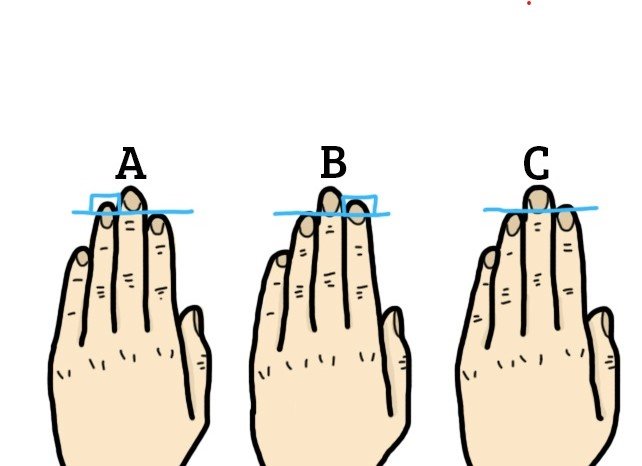
Some pseudoscientific ideas hold that a person’s personality is “defined” by the length of their fingers, especially those that have to do with palmistry or hand analysis.
Physical traits like finger length cannot accurately predict personality since personality is impacted by a complex interplay of genetic, environmental, and psychological variables. However, other people have different opinions.
Certain features of a person’s personality may be readily ascertained based on a pseudoscientific notion known as the “digit ratio,” which focuses on the ratio between the index finger (2D) and the ring finger (4D).
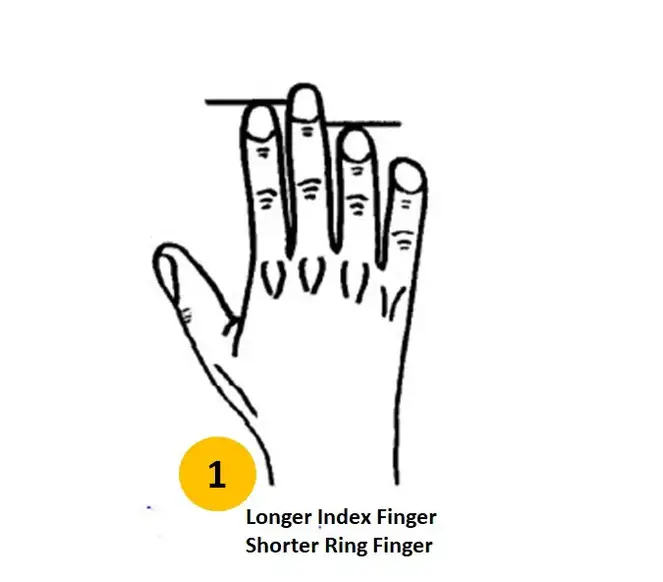
Here are a few examples of interpretations:
Extended Ring Finger (Low 2D:4D Ratio): Individuals with longer ring fingers are often seen as risk-takers, aggressive, and high self-esteem. Additionally, it is said that these individuals are gregarious, ambitious, and competitive.
Greater Compassion, Emphaticness, Communication, and Nurturing are Associated with Longer Index Fingers (High 2D:4D Ratio). Conflicts are often avoided by these people.
Equivalent Length: These people may be both aggressive and compassionate at the same time, acting either cooperatively or competitively according on the situation
Evolutionary biologist John Manning, who is currently at Swansea University, is credited with developing the theory that major personality traits may be inferred from finger lengths, according to Science. In little over two decades, his study has sparked over 1,400 investigations that have connected finger ratios to personality, cognitive function, and illness risks. These ratios have even been utilized by some scholars to make gender-related assumptions about prehistoric cave artists.
Furthermore, the journal notes that when researchers connected fetal testosterone to behavior and brain development in the late 1950s, finger ratios became a viable remedy. Scientists utilize finger ratios as a non-invasive method to research qualities like aggressiveness and sexual orientation that are impacted by prenatal hormones because fetal hormone collection is dangerous.